Dehumidifier for the basement: which device helps & what it costs
Which dehumidifier really helps in the basement – and how do you run it correctly? Here you will find my basement recommendation from my own dehumidifier test with measurements at 25 °C and at a cool 15 °C, plus the causes of damp basements, tips on ventilating in summer, the right target humidity and what continuous operation costs.
Key facts at a glance
- Basement test winner: Comfee 30L – 740 ml of water per hour, still 695 ml at 15 °C, with hose connection for continuous operation.
- Small basements up to approx. 10 m²: Okyuk 12L – compact and hardly weaker at 15 °C.
- Target value: Set the hygrostat to about 50–60 % – according to the German Environment Agency (UBA), the risk of mould increases if humidity stays above 60 % for long periods.
- Summer trap: Don’t ventilate on warm, humid days – the warm air condenses on the cold basement walls.
All measured values come from my own dehumidifier test; I bought the devices myself. Links marked with * are affiliate links: if you buy through them, I receive a small commission – the price stays the same for you.
Basement dehumidifiers compared
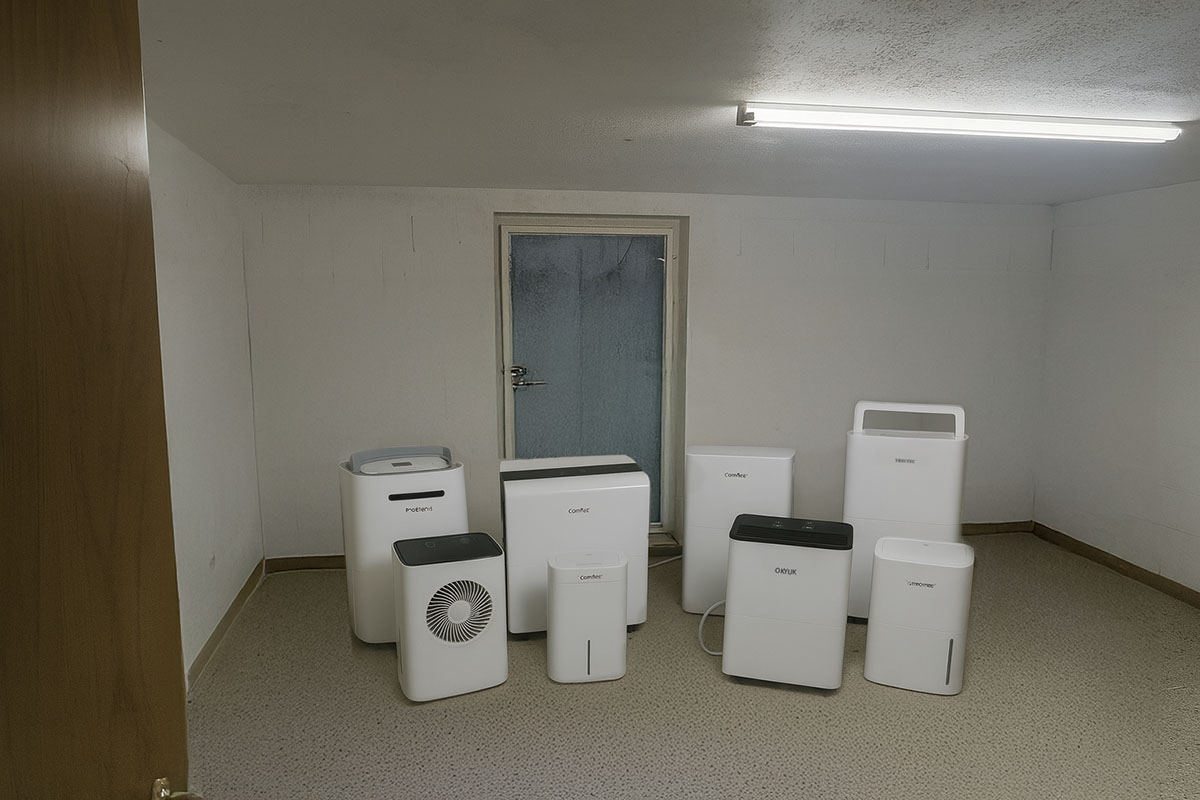
Basement test winner Comfee 30L – by far the highest dehumidification, even at 15 °C. Noise hardly matters in a basement.
| Model | Rated capacity (manufacturer) | Measured at 15 °C / 70 % | Measured at 25 °C / 60 % | Noise | Water tank | Hygrostat deviation | Link |
|---|---|---|---|---|---|---|---|
| Comfee 30LBasement test winnerIdeal for: basements, large & cool rooms from 40 m² | 30 l/24 hS | 695 ml/hM | 740 ml/hM | 50–55 dBM | n/a | a few %M | View on Amazon* |
| Okyuk 12LFor small basementsIdeal for: small basements up to approx. 10 m², living spaces | 12 l/24 hS | almost the sameM | 210 ml/hM | 36–41 dBM | 2.5 lS | ± 4 %M | View on Amazon* |
| Pro Breeze 20LLargest tankIdeal for: laundry rooms, medium-sized basements | 20 l/24 hS | n/a | n/a | 50–55 dBM | 5.5 lS | n/a | View on Amazon* |
| Comfee 10LWith frost protection modeIdeal for: small, unheated basement rooms | 10 l/24 hS | n/a | n/a | clearly audible | 2 lS | n/a | View on Amazon* |
| Newentor 20LFor large roomsIdeal for: rooms up to 50 m², basements | 20 l/24 hS | n/a | n/a | 39 dBS | n/a | n/a | View on Amazon* |
| Klamer 20LHigh air circulationIdeal for: laundry rooms, drying laundry | 20 l/24 hS | n/a | n/a | quiet during the day, too loud at night | n/a | ± 5 %M | View on Amazon* |
M = measured myself (reference: calibrated Temtop hygrometer) · S = manufacturer specification · “n/a” = measured value not yet documented. Dehumidification = amount of water collected in 1 hour; the measurement at 15 °C / 70 % corresponds to typical basement conditions. * Affiliate link: if you buy through it, I receive a small commission – the price stays the same for you.
My recommendations for the basement
Comfee 30L
Ideal for: basements, laundry rooms, large rooms from 40 m²
- 740 ml/h at 25 °C / 60 %
- 695 ml/h at 15 °C / 70 % – only about 6 % less
- Hose connection for continuous operation
Catch: around 18 kg and 50–55 dB – not a problem in a basement.
View on Amazon*Okyuk 12L
Ideal for: small basements up to approx. 10 m², occasional damp
- 210 ml/h at 25 °C, almost the same at 15 °C
- compact: 7.6 kg, 2.5 l tank
- quiet: 36–41 dB
Catch: too weak for large basements and continuous operation.
View on Amazon*Pro Breeze 20L
Ideal for: laundry rooms, medium-sized basements
- 5.5 l tank – empty it less often
- approx. 12 kg, castors
- Hose connection, automatic shut-off
Catch: 50–55 dB; dehumidification value not yet documented here.
View on Amazon*Comfee 10L
Ideal for: small, unheated basement rooms
- Frost protection mode
- simple operation, castors
- 10 l/24 h (manufacturer specification)
Catch: small 2 l tank, clearly audible; dehumidification value not yet documented.
View on Amazon*The basement dehumidifiers tested individually


It quickly became clear during testing: If you want to noticeably reduce humidity, you should look at models from around 10 l/24 h. Even in small rooms – such as a bathroom of only 4 m² – mini devices can hardly keep up. After all, the real purpose of a dehumidifier is to reliably reduce moisture and thus prevent mould and create a pleasant indoor climate.
Comfee dehumidifier – 30L/24h – basement test winner


✅ Advantages
❌ Disadvantages
Dehumidification performance & use in the basement
The Comfee already impressed in our dehumidifier test for living rooms and bedrooms – it came in right behind the OKYUK there. For the basement it takes the test win, because its power makes it particularly suited to larger and damper rooms such as basements.
At 25 °C and around 60 % humidity, it extracts approx. 740 ml of water per hour – and still 695 ml at a cooler 15 °C and 70 % humidity. Values at which smaller 10–20 l models have long reached their limits. In damp basements or large areas, it noticeably improves the indoor climate after a short running time.
Size & noise
At almost 18 kg, the Comfee is one of the heavier models – the castors keep it mobile, but compared with compact devices it is more of a “chunk”. The noise level is around 50–55 dB, which is borderline for living rooms or bedrooms but no problem in a basement.
Operation & functions
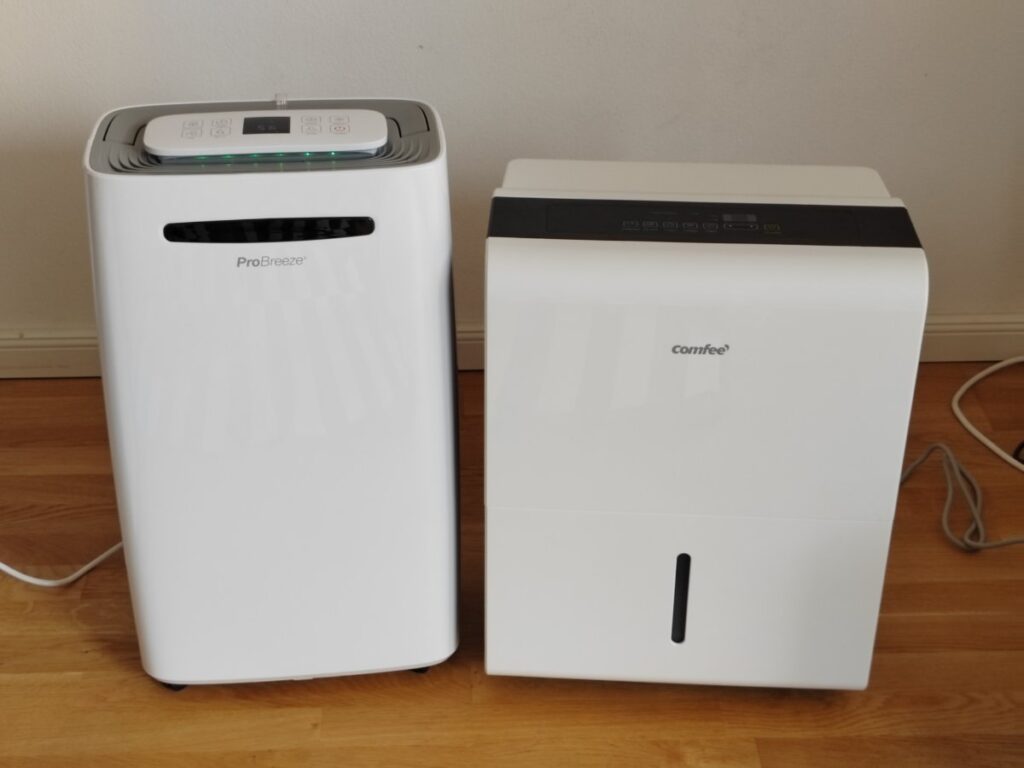
The hygrostat display measures precisely and deviated by only a few percent from the reference device in the test. For comparison: the Pro Breeze 20 l often showed values around 10 % higher. Operation is simple, with automatic mode, continuous mode, timer and target value control. A drain hose can be used for continuous operation in the basement.
Value for money
In terms of price, the Comfee is almost on a par with the Pro Breeze 20 l, but offers more power, a more accurate display and better features – clear advantages for larger basements.
Conclusion
If you want to dehumidify very damp basements or large rooms reliably, the Comfee 30 l is a real powerhouse. It is heavier and louder than compact models, but delivers unbeatable dehumidification performance for its price range. Clearly our recommendation for the basement and continuous operation.
Okyuk dehumidifier – 12L in 24h dehumidification capacity – for small basement rooms (test winner for living spaces)


✅ Advantages
❌ Disadvantages
At 25 °C and approx. 60 % humidity the device extracts around 210 ml of water from the air per hour. Even at 15 °C and 70 % the performance remains almost as strong – a big advantage over many other models whose performance drops significantly at cooler temperatures.
In small basements up to 10 m² the model works excellently and noticeably lowers humidity. In larger basement rooms from about 40 m² it reaches its limits, however, as the dehumidification capacity and the 2.5-litre tank are not sufficient for continuous operation.
Size, noise & handling
At only 7.6 kg the dehumidifier is one of the more compact devices and is easy to move thanks to its castors. The noise level is 36–41 dB which makes it extremely quiet – although this advantage hardly matters in a basement, where noise is usually secondary. For living rooms, on the other hand, it is one of the quietest in the test.
Build quality & operation
The device feels well made and looks much smarter than the larger basement models such as the Comfee 30 l/24 h. The humidity display works precisely and deviates by only approx. ±4 % from my calibrated Temtop meter. It offers automatic mode, adjustable target values, continuous operation with hose connection and two power levels.
Use cases compared
- Living rooms / bedrooms: here it is my clear favourite because it is quiet, compact and reliable.
- Small basements (up to 10 m²): well suited for occasional dehumidification after rain or in damp seasons.
- Large basements (from 40 m²): here the power and above all the tank volume are not enough – for continuous operation I recommend more powerful models such as the Comfee 30 l/24 h, my basement test winner.
Conclusion
For smaller basements this dehumidifier is a good choice if you value quiet operation and a compact design in particular. However, if you want to dehumidify larger basement rooms or if you are looking for a device for continuous use you should go straight for a more powerful model instead.
Pro Breeze 20l/24h – largest water tank and solid performance


The Pro Breeze dehumidifier with 20 litres per day was a real positive surprise in my test – what looks like a typical white household dehumidifier at first glance turns out in everyday use to be a powerful helper against high humidity, mould and musty basements.
Compact & flexible in the basement
The dehumidifier is compact and can easily be moved between basement rooms thanks to its castors and carrying handle – with dimensions of 25 × 39 × 66 cm it also fits well into narrow basement niches. Particularly practical in the basement: it can also help with drying laundry and noticeably shorten drying time.
Operation & functions
Operation is kept simple: set the target value, switch on, done. The LED display reliably shows the current humidity, and the hygrostat adjusts automatically. For continuous operation in the basement, you can connect a drain hose – ideal if you don’t want to keep emptying the tank. If the large 5.5-litre tank is used, the device switches off automatically as soon as it is full.
Performance in the basement
In the practical test, the Pro Breeze extracts at 25 °C and approx. 60 % humidity around 430 ml of water per hour. Even at a cooler 15 °C and approx. 70 % it still manages about 320 ml per hour – absolutely sufficient for most basement sizes. Compared with smaller 10 or 12 litre devices, it delivers noticeably more power and keeps even larger rooms dry in the long term.
Noise
At 50–55 dB the Pro Breeze is about as loud as the Comfee 30 l/24 h. That would be disturbing in a bedroom, but in the basement it makes no difference – what counts there is performance and tank size.
Comparison with Comfee & other models
In a direct comparison with the Comfee 30 l the Pro Breeze has slightly less power, but scores with the largest tank in the test (5.5 l) and its lower weight of just under 12 kg. It is easier to move, more practical for everyday use and needs emptying less often. Anyone who needs maximum dehumidification for very large basements should go for the Comfee; anyone looking for a good balance of performance, mobility and tank volume is well served by the Pro Breeze.
Conclusion
For basements up to medium size the Pro Breeze 20 l is a very good choice: large tank, continuous operation possible, solid performance even at cooler temperatures. Noise is secondary in the basement and the castors make it easy to position. For even more power – for example in very large basements over 40 m² – the Comfee 30 l is an even stronger alternative.
Comfee dehumidifier 10L/24h, room size approx. 40m³ (16m²)


✅ Advantages
❌ Disadvantages
With a dehumidification capacity of up to 10 litres per day, the device is ideal for rooms up to about 16 m² (approx. 40 m³). This also shows in practice: after just 30 to 45 minutes there was a noticeable difference in air quality. In the bathroom in particular, I was able to significantly reduce the drying time of my hung-up laundry.
Operation is intuitive and simple – ideal if you just want a reliable device without frills. The LED display lets you set target humidity values between 35 % and 85 %, as well as a timer and various modes. Personally, I find the reduced menu very pleasant – less is sometimes more.
I was also pleasantly surprised by the device’s mobility: castors and a carrying handle make moving it child’s play. A clever detail is the frost protection mode, which switches on automatically and protects the device from cold damage – this was particularly important in the unheated basement.
There are a few minor drawbacks, however. The operating noise is clearly audible, especially in very quiet rooms. It is not an unpleasant sound – more of a steady whoosh – but I would not run it in the bedroom at night. The water tank is also relatively small (2 litres), so it fills up quickly in high humidity and has to be emptied more often.
Another detail: there is an automatic shut-off when the target value is reached or the tank is full – but a simple timer function for “run for x hours and then switch off” is missing. That would have been a practical feature.
Despite these minor points of criticism, I am very satisfied with the Comfee dehumidifier. It delivers strong performance, is solidly built and does exactly what it should: reliably dehumidify the room air. If you are looking for a simple, effective device for typical living spaces, you definitely can’t go wrong with this model.
KLAMER dehumidifier electric 20L – 180m³
✅ Advantages
❌ Disadvantages
A big plus is the high air circulation of 180 m³/h, which is reflected in how quickly it works. Rooms are pleasantly dry again within a short time. I was particularly impressed by how efficiently the dehumidifier works when drying laundry. Humidity drops and laundry dries faster – without unpleasantly stuffy air.
The device is pleasantly mobile. With four castors and a practical handle, it is easy to move. Despite its power, the KLAMER is comparatively quiet – ideal for living rooms during the day. In operation, however, it is too loud for the bedroom, which many buyers also confirm. It is therefore better to switch it off at night.
Operation is intuitive. I particularly like the three-colour LED indicator for the current humidity status (blue, green, red). The humidity display is also surprisingly accurate – compared with an external hygrometer, the values were only about 5 % apart.
A minor point of criticism is the position of the water tank: it is located at the back – together with the fill level indicator. This makes handling in small rooms somewhat awkward, as you may have to turn the device to see the water level or remove the tank. When emptying, you should also switch the device off a few minutes beforehand, otherwise water may drip out.
All in all, the KLAMER dehumidifier is a real workhorse – reliable, well designed and efficient. Build quality is high and the value for money is absolutely right. If you can live with removing the tank from the back, you get an all-round successful device that does its job excellently.
Newentor 20L dehumidifier electric, basement, 39dB
✅ Advantages
❌ Disadvantages
The device not only works efficiently but also extremely quietly. At just 39 dB in operation, it is even suitable for sensitive environments such as bedrooms or living rooms.
The indoor climate improved noticeably after just a few hours. Especially in the bathroom, where a lot of moisture is often produced, I noticed a clear reduction. In the basement, too, the air now feels much fresher and more pleasant. The dehumidifier keeps humidity constantly at a low level – ideal for preventing mould.
Operation could hardly be easier: the touch display is clear, shows the current humidity and allows precise control of the target values. The supplied 1.5 m drain hose is a real convenience – you don’t have to keep emptying the tank. If you still prefer the tank, you get a sufficiently large volume and an automatic shut-off when the tank is full.
Visually, the device looks modern and high-quality. It blends in unobtrusively, takes up little space and can be moved quickly when needed. Thanks to its compact design and well-thought-out construction, it is suitable for rooms up to 50 m² or 150 m³.
Besides its performance, a definite highlight is its energy efficiency: even with regular use, I could not see a noticeable increase in my electricity consumption. The device works reliably, efficiently and without annoying background noise. An all-round successful package.
I would also like to highlight the 10-year warranty – a strong sign of confidence from the manufacturer. For me, a clear plus and an expression of quality and durability.
How I tested
The measured values on this page come from my dehumidifier test: amount of water collected in one hour at approx. 25 °C / 60 % and at approx. 15 °C / 70 % humidity. The cooler measurement corresponds to typical basement conditions.
My test mainly included models with 10–30 litres per day – including well-known manufacturers such as Comfee, Pro Breeze, Okyuk, Colaze and Newentor. The focus was on basements with moisture problems: What mattered were dehumidification capacity, continuous operation, automatic shut-offs and the most energy-saving operation possible.
Noise played a minor role, as basements are generally not lived in permanently.
A calibrated Temtop meter served as the humidity reference. In the basement, what counts above all is dehumidification performance in the cold; noise hardly matters – which is why the Comfee 30L is my test winner here, while the quieter Okyuk 12L wins for living spaces.
The table marks my own measurements (M), manufacturer specifications (S) and values not yet documented (n/a).
Why is my basement damp? The most common causes
Damp in the basement can have many causes – often several factors come together.
A common trigger is structural weak points: cracks in the walls, leaking joints or poorly sealed floors let water in from outside. Older buildings in particular often lack modern waterproofing, so rainwater or soil moisture easily finds its way into the masonry.
Equally typical is condensation. Warm, humid air from the living area or from outside hits the cool basement walls and floors, cools down and settles as water. Because basements are usually cooler and less well ventilated, this happens especially often here – an ideal breeding ground for mould.
Then there is groundwater – it can be a problem, especially in regions with a high water table or after heavy rainfall. The water then presses against the walls from below or from the side and causes persistent damp.
Everyday factors make things even worse: drying wet laundry in the basement or exercising there noticeably increases humidity. Sweat and wet clothing release water into the air – which in turn condenses on the cold surfaces.
Summer is particularly tricky: Basements are usually unheated and cool even in summer. If warm outside air flows in on humid days, its moisture condenses on the cold basement walls – according to Stiftung Warentest ventilating can then even do harm.
To improve the situation in the long term, you first need to know the cause. Then targeted measures help: external waterproofing, better ventilation, regular airing – and a dehumidifier that permanently reduces excess moisture to a healthy level.
Ventilating the basement correctly – especially in summer
Ventilating correctly is more difficult in a basement than in a flat. The most important rule: only ventilate when the outside air is cooler than the basement air – in summer, that means at night or early in the morning rather than on humid afternoons.
Place shelves and cupboards a little away from the outside walls so that air can circulate there – this is also recommended by Stiftung Warentest. Check the humidity with a hygrometer. If ventilating is not enough, a dehumidifier with hygrostat reliably keeps humidity below 60 %.
What humidity is normal in a basement?
For living spaces, the German Environment Agency (UBA) recommends 40–60 % relative humidity. If it stays above 60 % for days, the risk of mould increases. For the basement, a hygrostat target of about 50–60 % is therefore a good guideline. Important: humidity is higher directly at cold walls than in the middle of the room.
It is always advisable to keep an eye on the humidity level. Suitable sensors cost no more than an ordinary thermometer.
Multifunctional meters that display humidity and temperature at the same time are recommended. They cost between €10 and €20.Relative and absolute humidity
To avoid misunderstandings in the rest of the article: there is absolute humidity on the one hand, and relative humidity on the other.
By absolute humidity, we mean the amount of water (usually in grams) contained in a certain amount of air (usually one cubic metre). Suppose a room contains 5 grams of water in every cubic metre of air. The absolute humidity is then 5 g/m³.
Relative humidity indicates the extent to which the air is saturated with water. That sounds more complicated than it is. Here is the explanation:
Warm air can hold more water than cold air. At 10 °C, air can hold a maximum of approx. 9.5 grams of water per m³. At 20 °C, it is approx. 17.5 grams [ 1 ] .
If we have one cubic metre of air at 10 °C containing 9.5 grams of water, the relative humidity is 100 %. No more water fits in. If it contains only 4.75 grams of water, i.e. half, the relative humidity is 50 %.
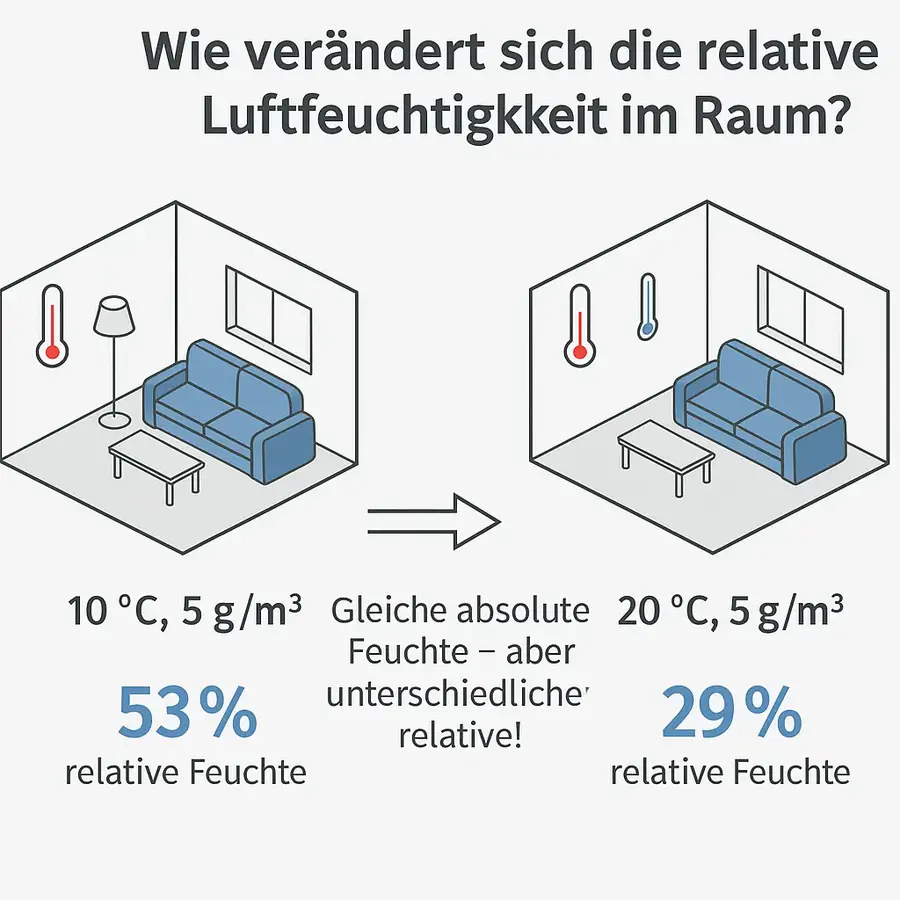
In short: Relative humidity indicates the percentage to which the air is saturated with water.
Continuous operation, running time & electricity costs in the basement
A typical dehumidifier draws between about 200 and 700 watts of power in operation – the exact value is given in the data sheet. According to Stiftung Warentest what matters more is the consumption per litre extracted: some devices take twice as long for the same amount of water. Example calculation: 250 watts × 6 hours = 1.5 kWh per day; at 40 cents per kWh that is around €0.60.
Power consumption depends on:
- Power input (watts): Higher power = more consumption, but possibly shorter running time
- Running time per day/week: Continuous operation without need drives up costs
- Setting & target value: The lower the target humidity, the harder the device has to work
- Room temperature: Many devices work less efficiently in cold rooms
- Device type & efficiency class: Older models without automatic shut-off or hygrostat consume more
This is how your dehumidifier becomes a power guzzler:
- If it runs constantly, although the problem could be solved structurally or by ventilating
- If it is undersized and never reaches the desired humidity
- If windows or doors are open and new moisture keeps flowing in
- If the wrong device types are used (e.g. condensation devices in a cold basement)
How long should a dehumidifier run in the basement?
In a basement, a dehumidifier usually runs longer than in a living space because moisture keeps coming from walls and floor. With a hygrostat, it switches off as soon as the target value is reached – Stiftung Warentest advises simply letting it run rather than constantly switching it off and on. For continuous operation, a drain hose leading directly into a drain is worthwhile.
Compressor or granules? Device types for the basement
Compressor dehumidifiers
Compressor dehumidifiers also cool the air – only the cooling method is different. In principle, the cooling works much like a refrigerator, which also contains a compressor. You can sometimes even hear it humming.
Let’s look at how cooling with a compressor works. It gets a little technical, but there is a practical summary at the end. Here we go:

Besides the compressor, the refrigerant is the key component of the cooling. Like water, the refrigerant can be gaseous, solid or liquid.
Water freezes at 0 °C and boils at 100 °C (at sea level); in between, it is liquid. The refrigerant, on the other hand, has a much lower boiling point and therefore evaporates even at room temperature.
When a liquid evaporates, whether water or refrigerant, it absorbs heat energy. After all, you have to put a pot of water on a hot hob to make the water evaporate.
Conversely, as soon as the vapour becomes liquid again – i.e. condenses – it releases this energy. And that is the whole principle:
If we make the refrigerant evaporate at one point, it absorbs heat energy there. We then lead the refrigerant to another point and let it condense there, releasing the absorbed heat energy.So we have transported heat from one place to another. The place from which we removed the heat has become colder. Logical, isn’t it?
Evaporating the refrigerant is easy. As mentioned, it evaporates even at room temperature. After the refrigerant has been led elsewhere, it is supposed to condense. But how do we do that? Wouldn’t we have to cool it again?
This is where the compressor comes in. It compresses the vapour, i.e. increases the pressure. Under high pressure, the temperature at which the refrigerant condenses rises. That is why it can now become liquid again at room temperature and release the absorbed heat.
Summary of how it works
The compressor dehumidifier cools the air, causing the water vapour in the air to condense on the cold cooling unit.
A refrigerant is used for cooling; it absorbs heat energy when it evaporates and releases it again when it condenses. As a result, the place where the heat energy is absorbed is cooled.
Advantages and disadvantages
Dehumidifiers that work with a compressor are more efficient than models with a Peltier element. They can extract more moisture from the air. Larger versions are used on building sites, among other things, and can remove several litres per hour from the air.
The downside is the noise. The device emits a hum similar to that of a running refrigerator.
Granule dehumidifiers
Granule dehumidifiers need no electricity, but only absorb a limited amount of water. They may be enough for small storerooms or occasional damp – for a permanently damp basement, an electric device is the better choice.
For very cold, unheated basements there are also desiccant dryers, which work without a refrigeration circuit. I have not tested such devices.
Buying guide: what matters in the basement
My test gives rise to these criteria for the basement – the most important first:
- Performance (litres per hour under real conditions)
- Performance in the cold – the most important criterion in the basement
- Hose connection & continuous operation
- Water tank
- Hygrostat accuracy
- Frost protection or automatic defrost
- Noise – secondary in the basement
- Power consumption (see Continuous operation & electricity costs)
Performance
For me, how much water the device can collect in a given time is the most important value. After all, it shouldn’t have to run all day, but make progress as quickly as possible.
Performance in the cold
Manufacturer specifications usually refer to 30 °C and 80 % humidity (e.g. Comfee MDDA-30DEN7 data sheet). In my test at 15 °C / 70 %, the Comfee 30L still extracted 695 instead of 740 ml per hour from the air, while the Okyuk remained almost as strong. Check the minimum operating temperature in the data sheet.
Water tank & hose connection
In a basement, a dehumidifier often runs for a long time. At 210 ml per hour, the Okyuk’s 2.5-litre tank is full after around 12 hours – the Comfee 30L collects many times that at 740 ml per hour. A device with a hose connection is therefore worthwhile for the basement; with 5.5 litres, the Pro Breeze also offers the largest tank.
Hygrostat accuracy
If the hygrostat shows values that are too high, the device runs unnecessarily long; if it shows values that are too low, the basement stays damper than you think. In my test, the displays deviated from a calibrated meter by a few percent up to around 5 % (Okyuk ± 4 %, Klamer ± 5 %). Check the value with a separate hygrometer at first.
Frost protection & automatic defrost
In cold basements, the heat exchanger can ice up. Devices with automatic defrost then switch off the cooling regularly. The Comfee 10L also has a frost protection mode – a real advantage in an unheated basement.
Noise
Noise is particularly important for models intended for use in private living spaces. A constant hum is disturbing when working, relaxing – and especially when sleeping. So check the manufacturer’s noise specification before buying. Values of around 40 dB are recommended for living spaces.
In the basement, noise is secondary: devices with 50–55 dB such as the Comfee 30L hardly disturb there. If there is a hobby room or bedroom in the basement, however, look for quiet models – my quietest device, the Okyuk, measured 36 dB.
Additional functions
Which Additional functions the dehumidifier has can be decisive when buying. As already mentioned, displays of the current temperature and humidity are practical. A timer or sensor control is even better. With the timer you can specify how long the device should run. A sensor control measures the humidity itself and switches the dehumidifier on and off automatically.
Frequently asked questions about basement dehumidifiers
Which dehumidifier is best for the basement?
In my test, the Comfee 30L: 740 ml of water per hour at 25 °C and still 695 ml at a cool 15 °C – by far the strongest value. At 50–55 dB it is loud, but that hardly matters in a basement. For small basements up to about 10 m², the Okyuk 12L is also sufficient.
What humidity is normal in a basement?
The German Environment Agency (UBA) recommends 40–60 % relative humidity for living spaces; if it stays above 60 %, the risk of mould increases. For the basement, a hygrostat target of about 50–60 % is therefore a good guideline.
How long does a dehumidifier need to run in the basement?
With a hygrostat, until the target value is reached – usually longer in the basement than in living spaces, because moisture keeps coming from walls and floor. Stiftung Warentest advises letting the device run rather than constantly switching it off and on.
Can I leave the dehumidifier running permanently in the basement?
Yes, if it has a hygrostat and a hose connection: it then switches off at the target value and the water drains directly into a drain. The Comfee 30L and Pro Breeze 20L have both.
How much electricity does a basement dehumidifier cost?
That depends on power input and running time: a 250-watt device running 6 hours a day consumes 1.5 kWh – at 40 cents per kWh, around €0.60 per day. The data sheet gives the exact value for your device.
Granules or electric – which is better for the basement?
Granule dehumidifiers need no electricity, but absorb only a little water and are suitable for small rooms or occasional damp. For a permanently damp basement, an electric device is the better choice.
Should I ventilate the basement in summer?
Only if the outside air is cooler than the basement air, for example at night or early in the morning. On warm, humid days, the moisture in the warm outside air condenses on the cold basement walls – according to Stiftung Warentest ventilating can then even do harm.
Is a dehumidifier in the basement worthwhile?
Yes, if humidity is regularly above 60 %, for example due to condensation in summer or drying laundry. If water enters through cracks or missing waterproofing, it only treats the symptom – then the cause must be fixed.
Conclusion
My conclusion for the basement: For damp and large basements, the Comfee 30L is my test winner – it still extracts almost 700 ml of water per hour from the air even at 15 °C. For small basements up to about 10 m², the compact Okyuk 12L is enough. Just as important as the device: ventilate correctly in summer and clarify the cause of the damp.
Keeping an eye on the indoor climate is always a good idea. If you notice increased humidity, the first step is correct ventilation.
But in some rooms this is not always easy. Whether because there are no windows, no proper cross-ventilation is possible, or simply because there are too frequent and too many humidity peaks (e.g. in the bathroom or kitchen).
If these options have been exhausted and the desired effect has still not been achieved, a dehumidifier helps. It often uses more energy than fans, but it removes moisture effectively.
Sources
- Wikipedia (German): Luftfeuchtigkeit (saturation amounts)
- German Environment Agency (UBA): Correct ventilation prevents mould (in German)
- German Environment Agency (UBA): FAQ on lowering room temperature (in German) (mould risk above 60 %)
- Stiftung Warentest: Dehumidifiers – what they can and cannot do (in German) (incl. basements in summer)
- Comfee MDDA-30DEN7 data sheet (manufacturer specification at 30 °C / 80 %)
- My own measurements with a calibrated Temtop meter, July 2025
