Best Fan Heater 2026: 8 Fan Heaters I Bought and Tested
 Tested by Maximilian Marx (B.Eng.) · 8 fan heaters bought myself · Updated: October 2026
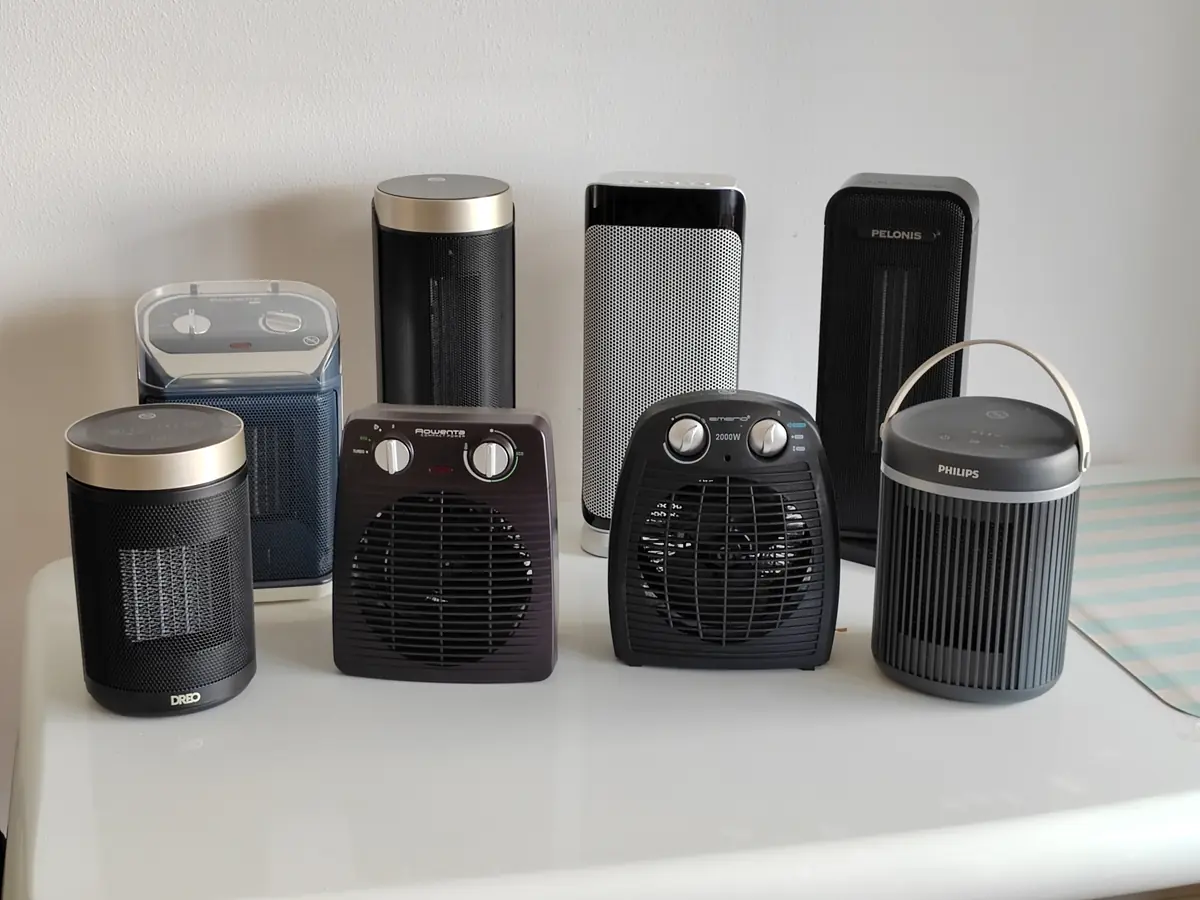
For this fan heater test I bought 8 heaters myself and tried them side by side on 3 August 2025: in a living room with a wooden floor and in a tiled room. I rated overall impression, controls, features, build quality and design, and recorded the noise with a smartphone app (not calibrated). I didn’t measure heat output or electricity use; instead you’ll find the running costs per hour, worked out at the current Ofgem price cap.
Key takeaways
- Test Winner: Dreo Solaris Slim H3 – ahead of the 7 other heaters on heat output, design, noise and features in a direct comparison (overall impression, not measured).
- Quietest Tested: Dreo Atom 316 – 45 dB on the highest setting (smartphone app, approx. 1 m), the lowest reading in my test, and very compact.
- Best Tower Alternative: PELONIS ceramic tower heater – very good overall impression, 53 dB on the highest setting.
- Bathroom Pick: Rowenta SO9281 Mini Excel Aqua – the only heater in my test with splash protection; UK rules in the section Fan heaters in the bathroom.
- Running costs: A 2,000 W heater costs about 53p an hour on full power (26.32p per kWh, Ofgem price cap October–December 2026) – calculation.
I bought all 8 fan heaters myself and tested them in practice; I didn’t use a measuring lab. Links marked with * are Affiliate links: if you buy through them, I earn a small commission at no extra cost to you. Four heaters are not available on amazon.co.uk – their links go to Amazon Germany, and those heaters come with an EU plug.
Contents
Fan heaters compared: my picks
4 fan heaters · Noise measured myself (smartphone app), other data per manufacturer
Updated: October 2026Test WinnerDreo Solaris Slim H3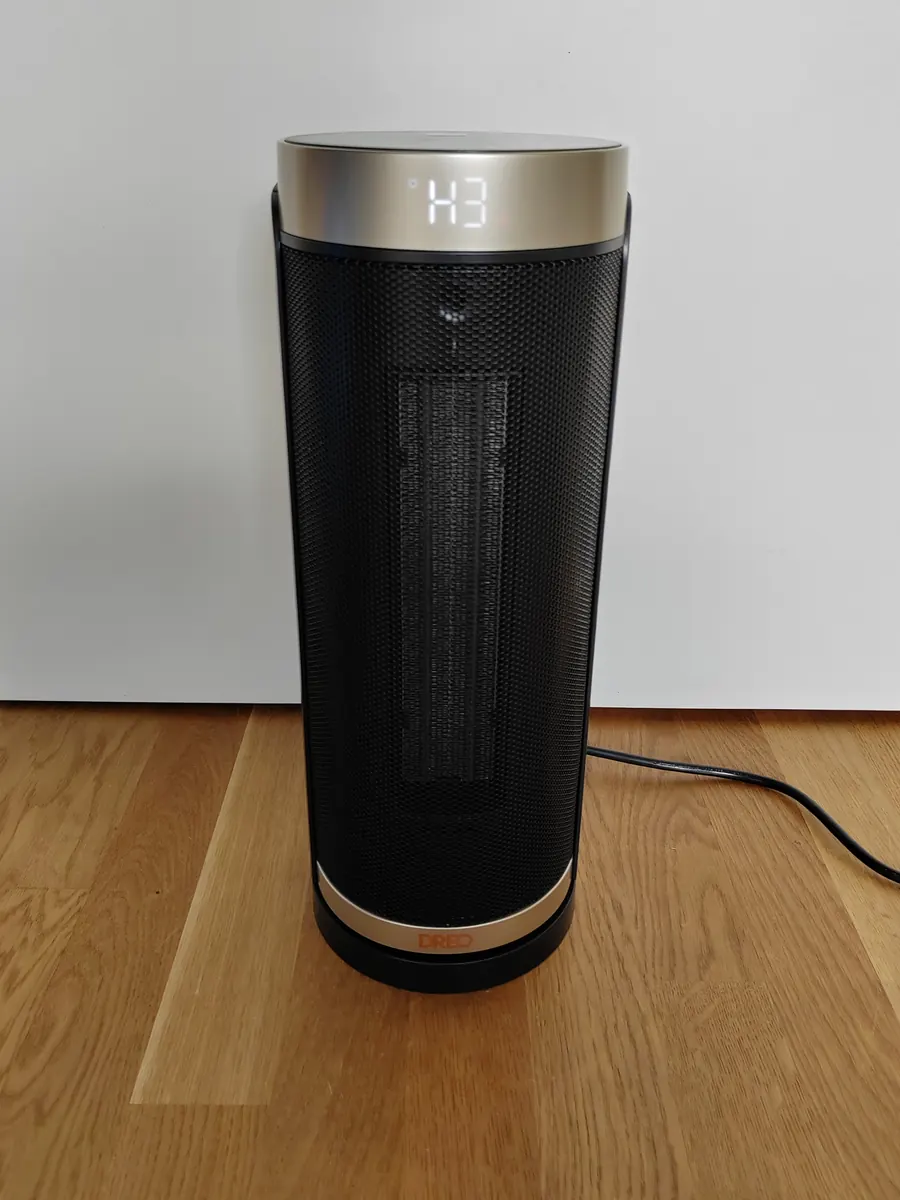 | Quietest TestedDreo Atom 316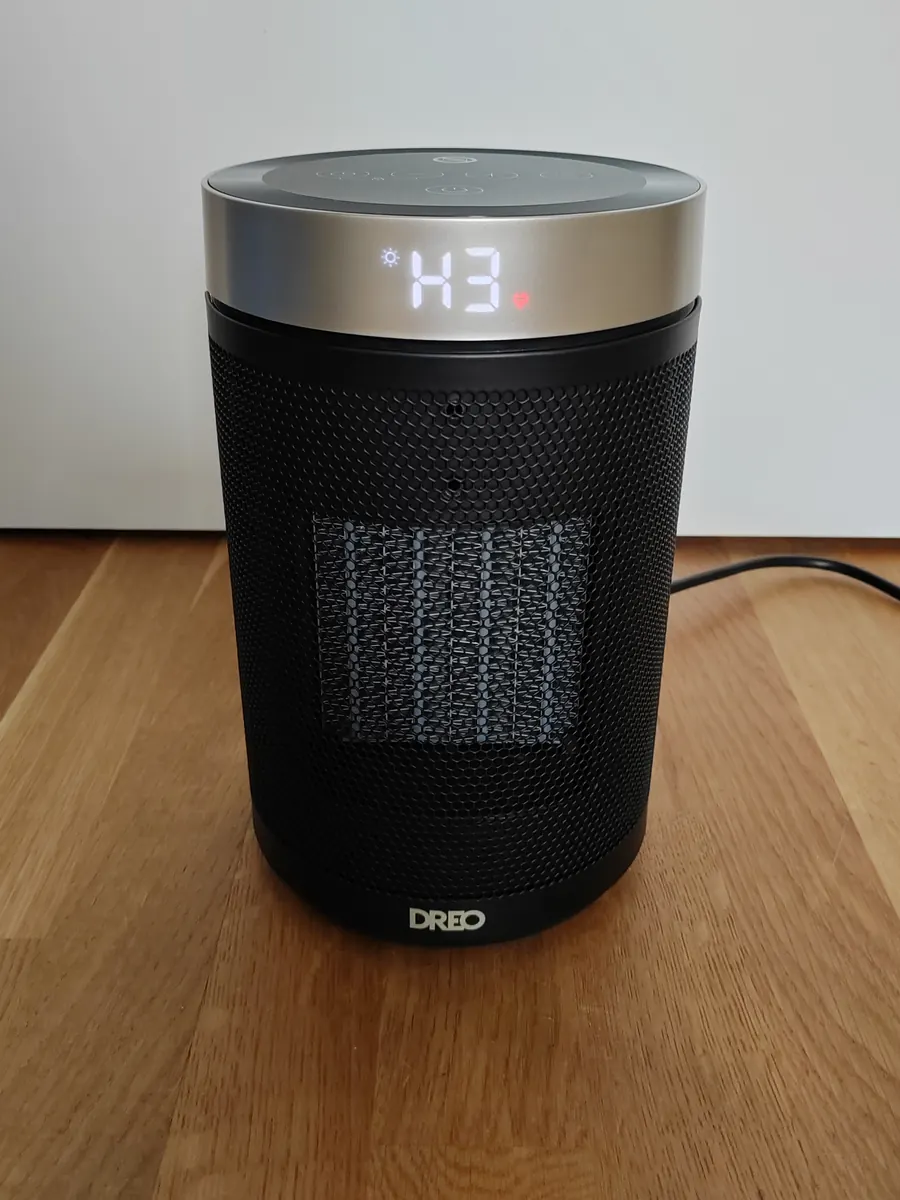 | Best Tower AlternativePELONIS ceramic tower heater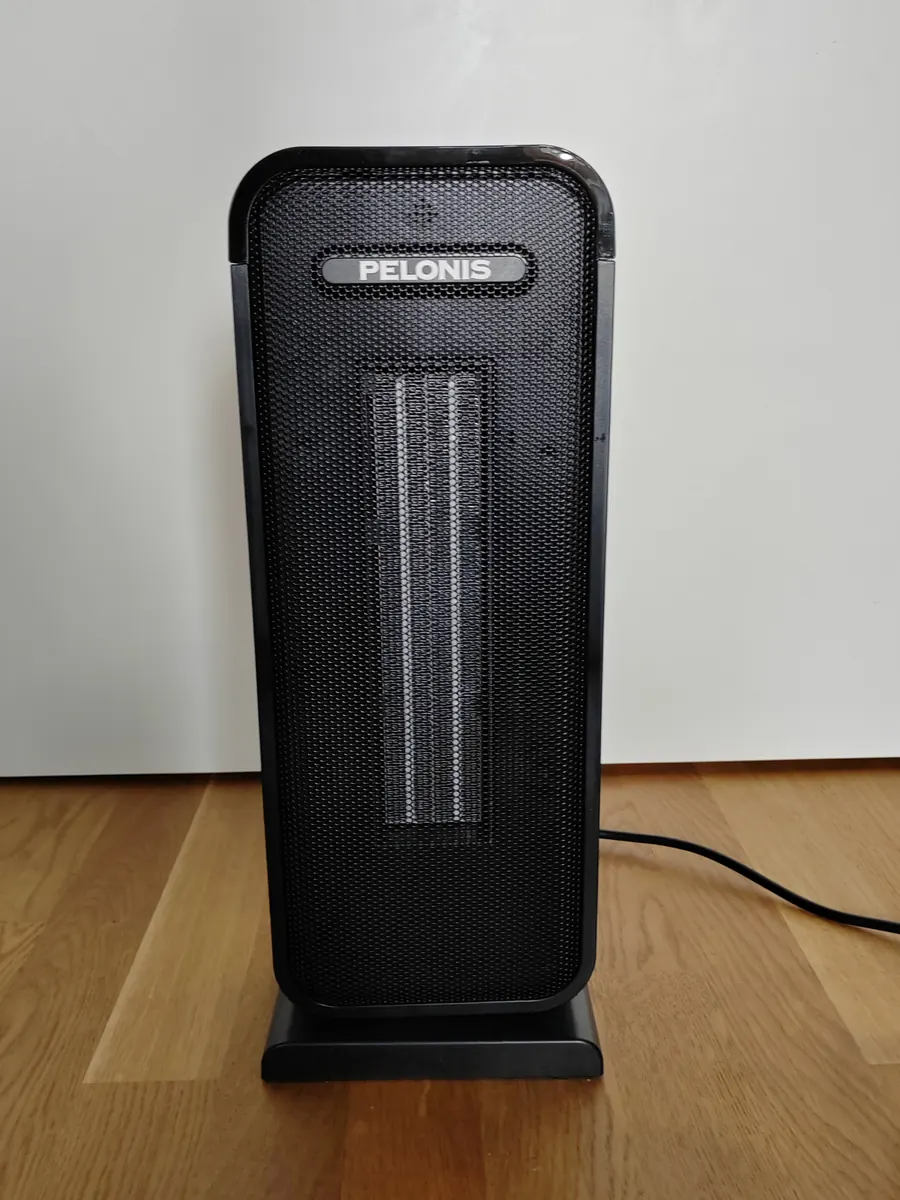 | Bathroom PickRowenta SO9281 Mini Excel Aqua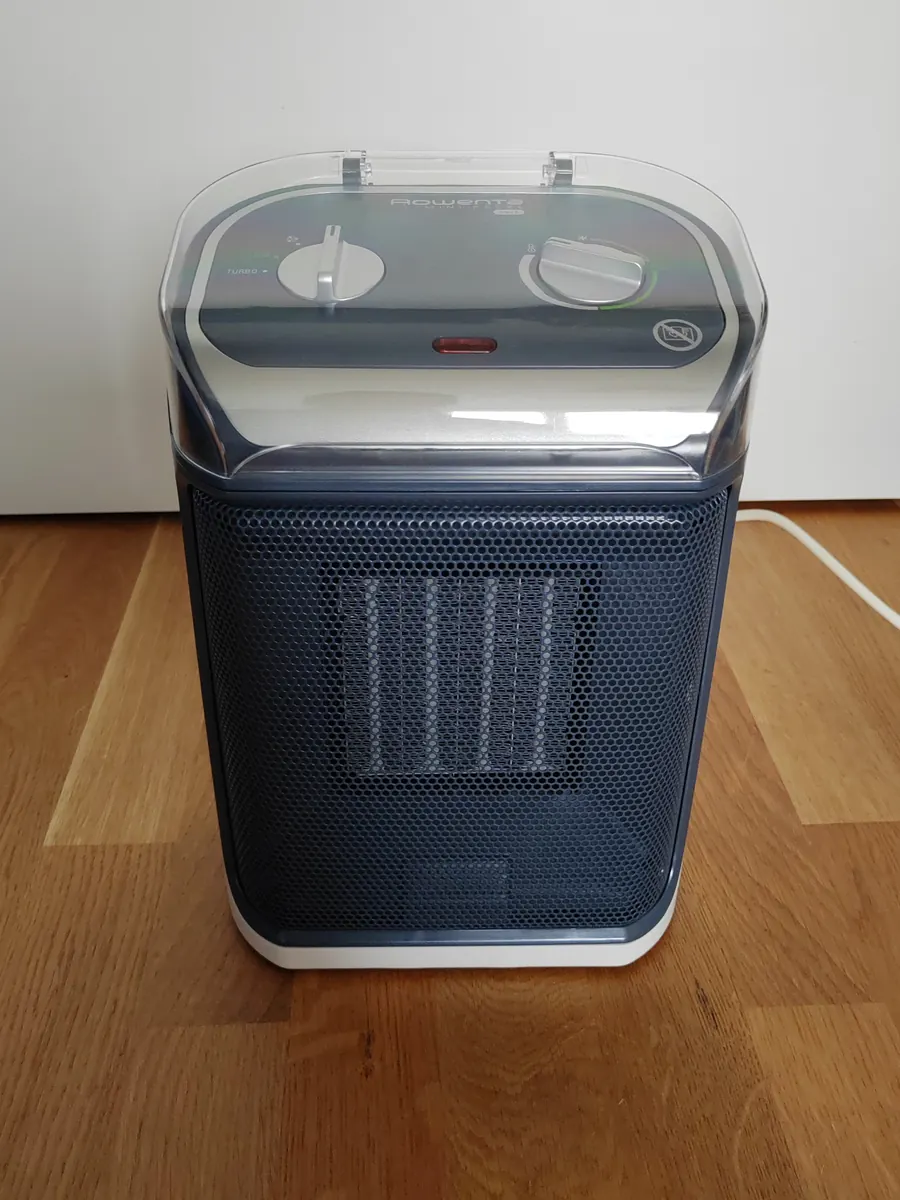 |
|---|---|---|---|
| My overall impression | |||
| best overall impression in my test | good, compact | very good | only heater with splash protection |
| Noise (app, highest setting, approx. 1 m) | |||
| n/a | 45 dBG | 53 dBG | 56 dBG |
| Noise per manufacturer | |||
| 37.5 dB (Dreo USA)H | 34 dBH | n/a | 50 dB(A)H |
| Power per manufacturer | |||
| n/a | 1,500 WH | 2,000 WH | 1,000 / 2,000 WH |
| Thermostat | |||
| 5–35 °CH | yes, 1 °C stepsH | digital, with LED displayH | yes, with frost protectionH |
| Timer | |||
| 1–12 hH | 1–12 hH | 12 hH | no timerH |
| Oscillation | |||
| 70°H | noneH | 75°H | n/a |
| Remote | |||
| yesH | only on units sold from 5 Sep 2025 (Amazon DE)H | yesH | no, dials only |
| Dimensions / weight | |||
| 18.6 × 18.6 × 43.6 cm, 2 kgH | 24.5 × 15.3 × 15.3 cm, 1.38 kgH | approx. 41 cm tall, 2.3 kgH | 20.6 × 14.6 × 30.8 cm, 1.82 kgH |
| Pros | |||
|
|
|
|
| Cons | |||
|
|
|
|
| View on Amazon* | View on Amazon* | View on Amazon* | View on Amazon* |
G = measured myself (smartphone app “Schallpegelmesser”, not calibrated; highest setting, approx. 1 m (3 ft)) · H = manufacturer claim · “n/a” = value not documented · * Affiliate link: if you buy through it, I earn a small commission at no extra cost to you.
My recommendations by use case
Dreo Solaris Slim H3
Best for: Living rooms – if you want a remote, oscillation and a timer (manufacturer data)
- Best overall impression: heat output, design, noise, features
- Remote, 70° oscillation, 1–12 h timer (manufacturer data)
- Slim tower, 18.6 × 18.6 × 43.6 cm (manufacturer data)
Catch: No dB reading of my own, power rating inconsistent.
View on Amazon*Dreo Atom 316
Best for: Small rooms up to about 15 m² (rule of thumb 100 W per m²), on a table or the floor
- 45 dB on the highest setting – lowest reading in my test
- 1,500 W, PTC ceramic, 1–12 h timer (manufacturer data)
- Much smaller than the tower heaters
Catch: Too weak for large rooms, no oscillation.
View on Amazon*PELONIS ceramic tower heater
Best for: Living rooms – as a tower alternative to the Dreo Solaris Slim H3
- Very good overall, about as tall as the Test Winner
- 53 dB on the highest setting (app)
- 2,000 W, 75° oscillation, 12 h timer (seller’s listing)
Catch: Seller data only, no other reviews; behind the Dreo in comparison; EU plug via Amazon Germany.
View on Amazon*Rowenta SO9281 Mini Excel Aqua
Best for: Bathrooms – short pre-heating, plugged into a socket at least 2.5 m from zone 1
- Only heater in my test with splash protection
- 56 dB on the highest setting (app)
- 1,000 or 2,000 W, frost protection (manufacturer data)
Catch: Dials only; IP21 (per MediaMarkt) is below IPX4, so keep it outside the bathroom zones.
View on Amazon*The fan heaters one by one
1. Test Winner: Dreo Solaris Slim H3
My Test Winner: side by side with 7 other fan heaters, it convinced me most overall on heat output, design, noise and features. Catch: I couldn’t document a noise reading for it, and the stated power differs from source to source.
Pros
- Best overall impression in a direct comparison
- Quiet in use (my impression)
- Slim tower with touch panel and display
- Remote, 70° oscillation, 1–12 h timer (manufacturer data)
Cons
- No noise reading of my own documented
- Power rating inconsistent (retailers 1,800 W, Dreo USA 1,000–1,500 W)
- Thermostat only works in ECO mode (Trusted Reviews)
| Noise (app, highest setting, approx. 1 m) | n/a |
|---|---|
| Noise per manufacturer (US version) | 37.5 dB H |
| Power | n/a |
| Heating element | PTC ceramic H |
| Thermostat | 5–35 °C H |
| Timer | 1–12 h H |
| Oscillation | 70° H |
| Safety | tip-over and overheat protection H |
| Dimensions / weight | 18.6 × 18.6 × 43.6 cm, 2 kg H |
| Updated | October 2026 |
My test report
Overall impression: I tried the Dreo Solaris Slim H3 on the same day, right next to the other seven fan heaters. Overall it came out on top. Four things decided it: heat output, design, noise and features. I didn’t measure the heat output – the verdict rests on the direct comparison.
Design & controls: The slim, tall tower is black with a gold-coloured ring at the top and bottom, and the housing is perforated. You operate it via a round touch panel on top with six symbol buttons. A digital display sits at the front near the top – it showed 35 °C in my test – and there’s a recessed grip at the back. It is much taller than the Dreo Atom 316 and about as tall as the PELONIS tower.
Noise: It sounded quiet to me. I still can’t give you a reading: there is no photo of the app measurement with the value on screen, so the table says “n/a”.
Manufacturer data: Among the features that won me over are the remote, oscillation, display and several modes. The details come from Dreo: a 1–12 h timer, 70° oscillation, an ECO mode with thermostat (5–35 °C), and tip-over and overheat protection. The power figures contradict each other: retailers state 1,800 W, while Dreo USA lists the same model number with 1,000–1,500 W at 120 V. Dreo’s German site only lists the successor H3S with 2,000 W. I didn’t write down the rating plate of my unit. (Sources: Dreo (Amazon listing H3), Dreo USA (H3), Dreo support (H3), Dreo Germany (H3S))
What other reviews say: Trusted Reviews tested the H3 with energy and airflow measurements and recommends it as a ceramic fan heater with a thermostat, but without smart features. Two points are criticised there: the thermostat can only be used in ECO mode, and the fan-only mode is weak (0.8 m/s from 15 cm). The German review site home&smart names it its test winner, but publishes neither its method nor any readings. (Sources: Trusted Reviews (H3), home&smart)
Verdict: If you want a fan heater with a remote, oscillation and a timer, the Dreo Solaris Slim H3 is my first choice from this test. If you need a smaller heater with a documented noise reading, go for the Dreo Atom 316.
Questions about the Dreo Solaris Slim H3
Can I set a timer on the Dreo Solaris Slim H3?
Yes. According to Dreo you can set a switch-off time of 1–12 h; when it runs out, the heater stops. Trusted Reviews describes the setting in one-hour steps. Dreo also lists a remote, 70° oscillation and an ECO mode with thermostat (5–35 °C). According to Trusted Reviews, the thermostat only works in ECO mode.
2. Quietest Tested: Dreo Atom 316
At 45 dB on the highest setting it gave the lowest reading in my test (the Solaris Slim H3 has none), and it is much more compact than the tower heaters. Catch: at 1,500 W (manufacturer data) it only suits smaller rooms.
Pros
- 45 dB – lowest reading in my test (app)
- Compact, fits on a table or the floor
- 1–12 h timer and thermostat (manufacturer data)
Cons
- 1,500 W (manufacturer data) – only for smaller rooms
- No oscillation (manufacturer data)
- Remote only with units sold from 5 Sep 2025 (Amazon Germany listing)
| Noise (app, highest setting, approx. 1 m) | 45 dB G |
|---|---|
| Noise per Trusted Reviews (max. setting, 1 m) | 44 dB Q |
| Noise per manufacturer | 34 dB H |
| Power | 1,500 W H |
| Heating element | PTC ceramic H |
| Timer | 1–12 h H |
| Remote | only on units sold from 5 Sep 2025 (Amazon DE) H |
| Dimensions / weight | 24.5 × 15.3 × 15.3 cm, 1.38 kg H |
| Updated | October 2026 |
My test report
Noise: On the highest setting the smartphone app showed 45 dB from about 1 m – the lowest reading in my test. For comparison, the Philips CX3120 reached 51 dB and the Rowenta SO2210 60 dB. The app isn’t calibrated, so the values are only useful for comparing the heaters with each other.
Size & design: The Atom 316 is a small black cylinder with a silver-gold ring that holds the digital display. In my test it showed “H3”, the heat setting. The touch panel is on top, with a recessed grip at the back. It is much smaller than the Philips CX3120 and the large Dreo and fits on a table or the floor.
Overall impression: Of the two Dreo heaters, it comes second for me behind the Solaris Slim H3: also good, but much more compact.
Manufacturer data: Dreo states 1,500 W, three heat settings, a 12-hour timer, ECO mode, fan-only mode and PTC ceramic, plus 34 dB. The Atom 316 has no oscillation. According to the Amazon Germany listing, a remote only comes with units sold from 5 September 2025; my unit came from an order in July 2025. The amazon.co.uk listing title mentions a remote, and the UK model Ideal Home reviewed came with one. The Wi-Fi version Atom 316 S is a separate model. (Sources: Dreo Germany (Atom 316), Dreo USA (Atom 316), Dreo (Amazon listing Atom 316), Ideal Home, amazon.co.uk listings)
What other reviews say: Trusted Reviews measured 44 dB from 1 m on the highest setting – close to my app reading. Ideal Home recorded 36 dB at most. For energy use, Trusted Reviews measured 1.5 kWh per hour in continuous mode and 0.51 kWh in ECO mode. Both reviews criticise the unlit touch buttons. According to a buying guide by the German retailer MediaMarkt, the Atom 316 was test winner at the German magazine Computer Bild (05/26, grade 1.5). (Sources: Trusted Reviews (Atom 316), Ideal Home, MediaMarkt guide)
Verdict: For small rooms and anywhere it needs to be quiet, the Dreo Atom 316 is my pick from this test. At 45 dB it had the lowest reading. If you want oscillation, go for the Dreo Solaris Slim H3 (70°, manufacturer data).
Questions about the Dreo Atom 316
Does the Dreo Atom 316 come with a remote?
On Amazon Germany, only units sold from 5 September 2025 include one; earlier units don’t. Check the listing before you buy. My test unit came from an order in July 2025. On amazon.co.uk the listing title mentions a remote, and Ideal Home’s UK review unit had one. Dreo’s German site contradicts itself: the specifications say no remote, the box contents list one.
3. Best Tower Alternative: PELONIS ceramic tower heater
Also very good overall and about as tall as the Test Winner – at 53 dB on the highest setting. Catch: I found no manufacturer website and no other reviews of this model; the features come only from the seller’s listing.
Pros
- Very good overall impression
- Display and six buttons on top
- 75° oscillation, remote, 12 h timer (seller’s listing)
Cons
- 53 dB – much louder than the Dreo Atom 316 (45 dB)
- No manufacturer website and no other reviews found
- Behind the Dreo Solaris Slim H3 in a direct comparison
- Not available on amazon.co.uk – link goes to Amazon Germany (EU plug)
| Noise (app, highest setting, approx. 1 m) | 53 dB G |
|---|---|
| Noise per manufacturer | n/a |
| Power | 2,000 W H |
| Heating element | PTC ceramic H |
| Thermostat | digital, with LED display H |
| Timer | 12 h H |
| Oscillation | 75° H |
| Safety | tip-over and overheat protection H |
| Weight | 2.3 kg H |
| Updated | October 2026 |
My test report
Overall impression: I also rated the PELONIS tower very good. In a direct comparison the Dreo Solaris Slim H3 came out ahead. The third tower in the test, the Brandson, felt cheaply made by contrast.
Design & controls: A black tower on a base with narrow air outlets at the front. On top sits the control panel with a display, which showed 35 °C in my test, and six buttons; next to it is the printed note “WARNING: Do not cover”. There’s a recessed grip at the back. It is about as tall as the Dreo Solaris Slim H3.
Noise: On the highest setting the smartphone app showed 53 dB from about 1 m. That puts it almost level with the Brandson tower (54 dB), but well above the Dreo Atom 316 (45 dB). The app isn’t calibrated.
Seller data: In its Amazon listing, PELONIS states 2,000 W, PTC ceramic, two heat settings plus ECO mode and a digital thermostat with LED display. Touch controls, a remote, 75° oscillation, a 12-hour timer and tip-over and overheat protection complete the list. There is no noise or IP rating. I couldn’t find a manufacturer website or manual for model PHF171BPBHDE. (Source: PELONIS (Amazon listing))
What other reviews say: I found no independent tests of this model: it doesn’t appear at Stiftung Warentest, ÖKO-TEST, Computer Bild or IMTEST (all German). TopRatgeber24 only lists it in an algorithm-based comparison without a test of its own. (Source: TopRatgeber24 (PELONIS))
Verdict: If the Dreo Solaris Slim H3 doesn’t appeal to you, the PELONIS is the best tower alternative from my test. If you want it as quiet as possible, take the Dreo Atom 316 instead. The model is currently not available on amazon.co.uk, so the link goes to Amazon Germany: that version has an EU plug, and a portable heater used in the UK should have a UK 3-pin plug.
4. Bathroom Pick: Rowenta SO9281 Mini Excel Aqua
The only heater in my test with splash protection – a transparent flap covers the dials, and Rowenta markets it for bathrooms. Catch: 56 dB on the highest setting, no display, and the IP21 stated by MediaMarkt is below the IPX4 that UK wiring rules ask for in zone 2.
Pros
- Only heater in my test with splash protection
- Explicitly marketed by Rowenta for bathrooms
- Thermostat with frost-protection setting (manufacturer data)
Cons
- Dials only, no display, no thermostat readout
- 56 dB on the highest setting
- IP21 per MediaMarkt – below IPX4
- No timer (manufacturer data)
| Noise (app, highest setting, approx. 1 m) | 56 dB G |
|---|---|
| Noise per manufacturer | 50 dB(A) H |
| Power | 1,000 / 2,000 W H |
| Splash protection | transparent cover over the controls H |
| Protection rating (per MediaMarkt guide) | IP21 – Rowenta gives no IP rating Q |
| Thermostat | yes, with frost protection H |
| Timer | no timer H |
| Safety | tip-over switch in 4 directions, cut-out with alarm H |
| Dimensions / weight | 20.6 × 14.6 × 30.8 cm, 1.82 kg H |
| Updated | October 2026 |
My test report
Splash protection: The SO9281 was the only heater in my test with splash protection – it is meant for bathrooms. A transparent flap sits over the two dials on top. The white and blue housing has a handle, and the air grille is at the back.
Noise & controls: On the highest setting the smartphone app showed 56 dB from about 1 m. Like the Emerio and the Rowenta SO2210, it only has dials – no display and no thermostat readout, which I found a weakness.
Manufacturer data: Rowenta markets the Mini Excel Aqua for safe use in the bathroom. It lists drip-proof protection, a transparent cover against splashes, a tip-over switch that works in four directions and a double safety cut-out with alarm. On top come two settings of 1,000 and 2,000 W, a thermostat with frost protection, a cool-air function and, according to Rowenta, 50 dB(A). Rowenta mentions neither a timer nor an IP rating. (Sources: Rowenta (SO9281), Rowenta manual (SO9281))
What other sources say: I found no lab tests of the SO9281. MediaMarkt’s buying guide recommends it as a bathroom model and gives IP21. Under BS 7671, zone 1 only takes fixed equipment and anything in zone 2 needs at least IPX4 – so keep this heater outside the zones and only plug it into a socket that is allowed there. More in the section Fan heaters in the bathroom and in my bathroom fan heater guide. (Sources: MediaMarkt guide, BS 7671 Section 701 (SELECT))
Verdict: For bathrooms, the Rowenta SO9281 Mini Excel Aqua is the only choice from my test, because only it has splash protection – in a UK bathroom only outside the zones and on a socket that complies with BS 7671. I don’t recommend it for living rooms because of the dials without a display.
Also tested
I bought these four fan heaters as well and tested them on the same day. They get no award: other heaters were quieter or convinced me more overall; with some, the dial-only controls or the build quality put me off.
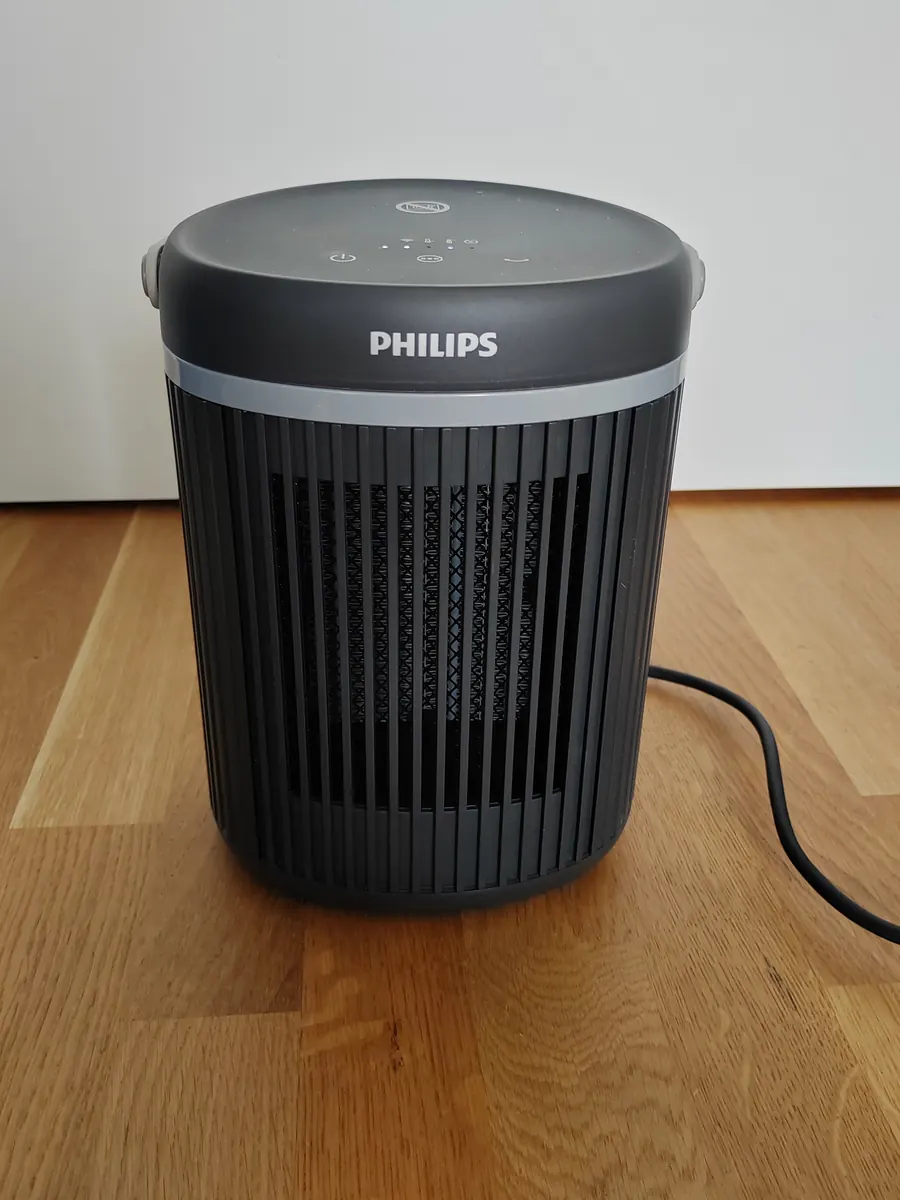
 Philips CX3120/01 Smart 3000On the highest setting the app showed 51 dB; a second reading at a setting I didn’t note gave 39 dB. It is the only smart heater in my test, and according to Philips you can control it with the Air+ app. Philips also lists 900, 1,200 and 2,000 W, a 1–12 h timer, 45° oscillation and a thermostat range of 1–37 °C. No award, because the Dreo Atom 316 was quieter and the Solaris Slim H3 convinced me more overall. (Source: Philips) View on Amazon*
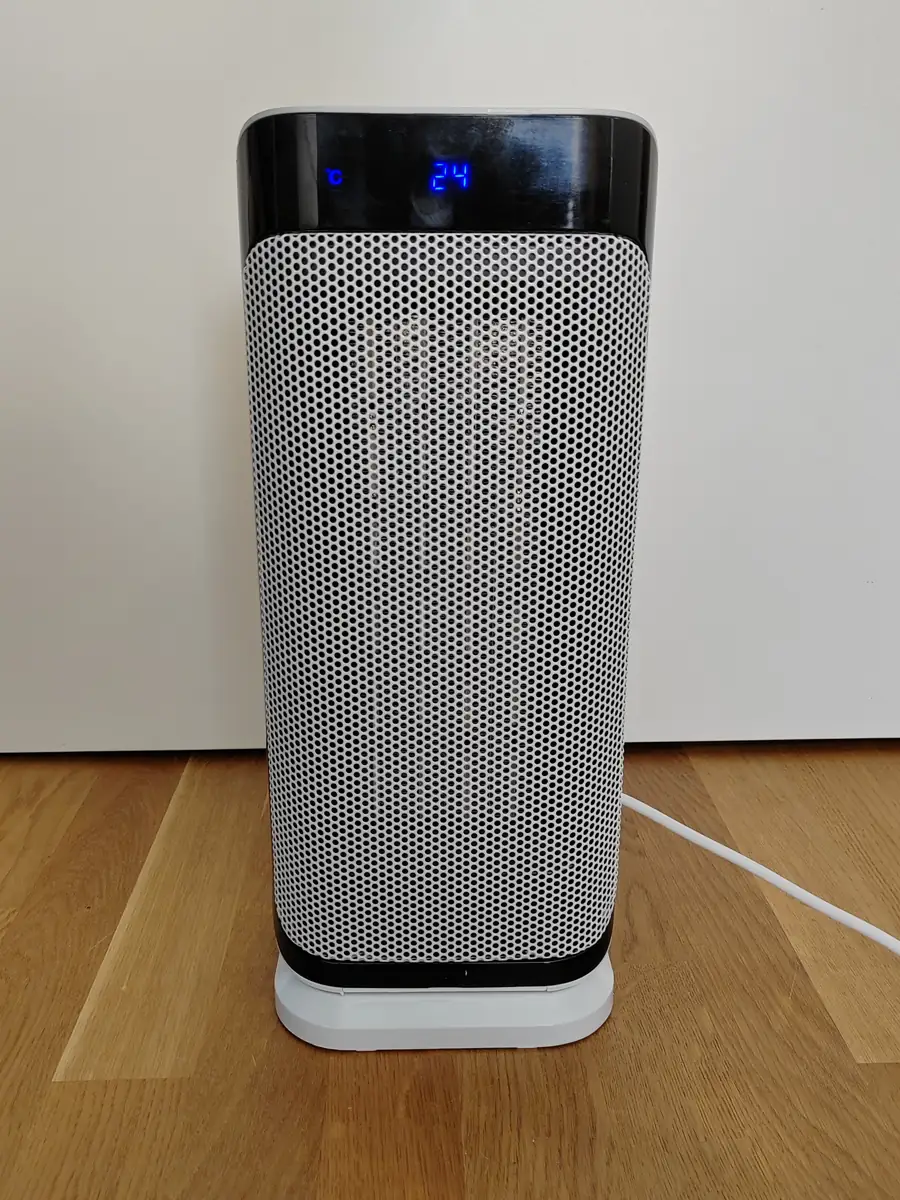
- Brandson ceramic tower heaterThe light grey and white tower with a blue digital display felt cheaply made to me. The app showed 54 dB on the highest setting; Brandson itself states about 47.5 dB(A). According to the manufacturer it has 1,000 or 2,000 W, a 1–8 h timer, a remote, switchable oscillation and protection rating IP20, so it doesn’t belong in a bathroom. I identified the model 303124 from my photos. It isn’t sold on amazon.co.uk, so the link goes to Amazon Germany (EU plug). (Sources: Brandson (Amazon listing), testbericht.de (Brandson)) View on Amazon*
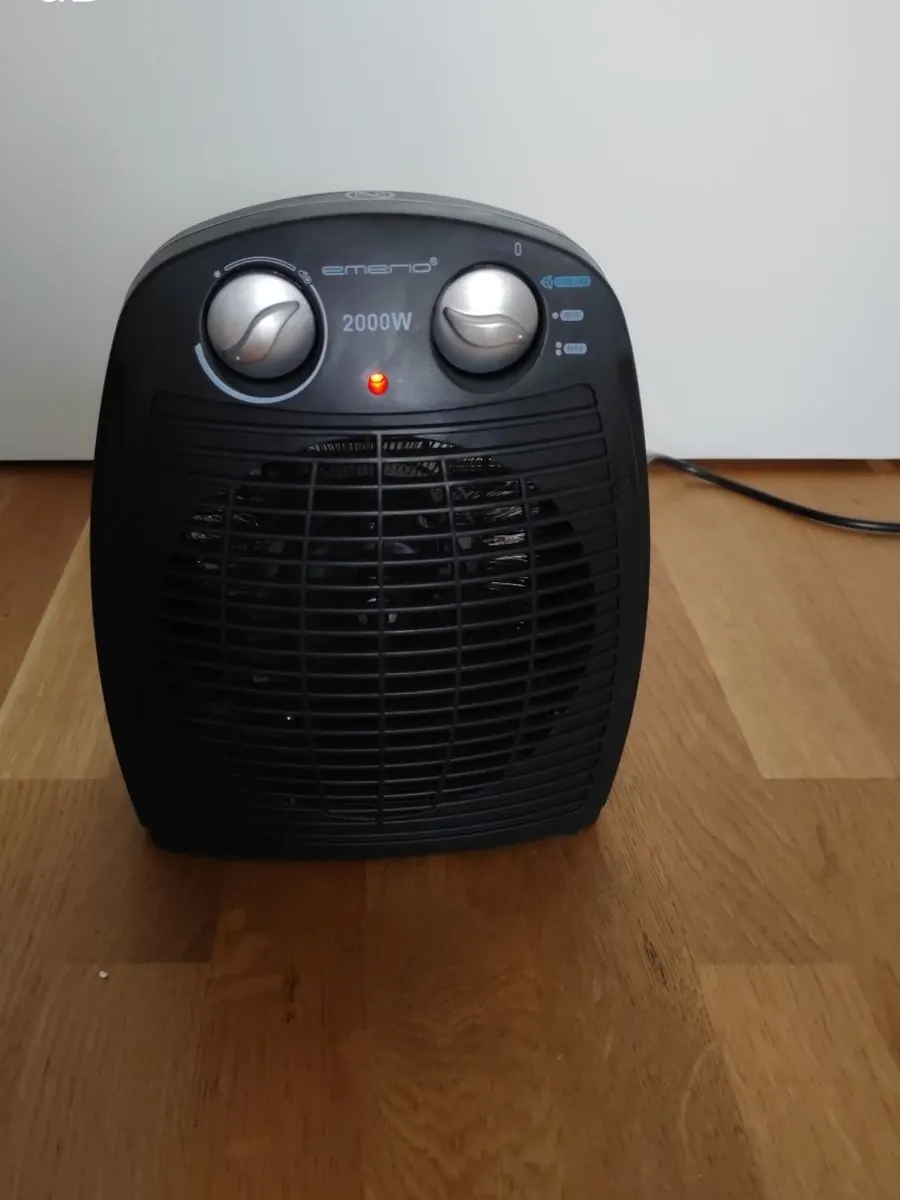
- Emerio FH-106737.2A simple, compact heater with two dials, no display and no thermostat readout – which I found a weakness. The app showed 57 dB on the highest setting. According to the manual it has 1,800–2,000 W, a mechanical thermostat and tip-over protection, but neither a timer nor a remote. It shouldn’t be used near a bath or shower. The model I tested (FH-106737.2) is no longer sold on Amazon, so the link goes to the current Emerio FH-111910.2 on Amazon Germany (2,000 W, IP21, oscillating, EU plug) – a different heater that I have not tested. (Source: Emerio manual) View on Amazon*
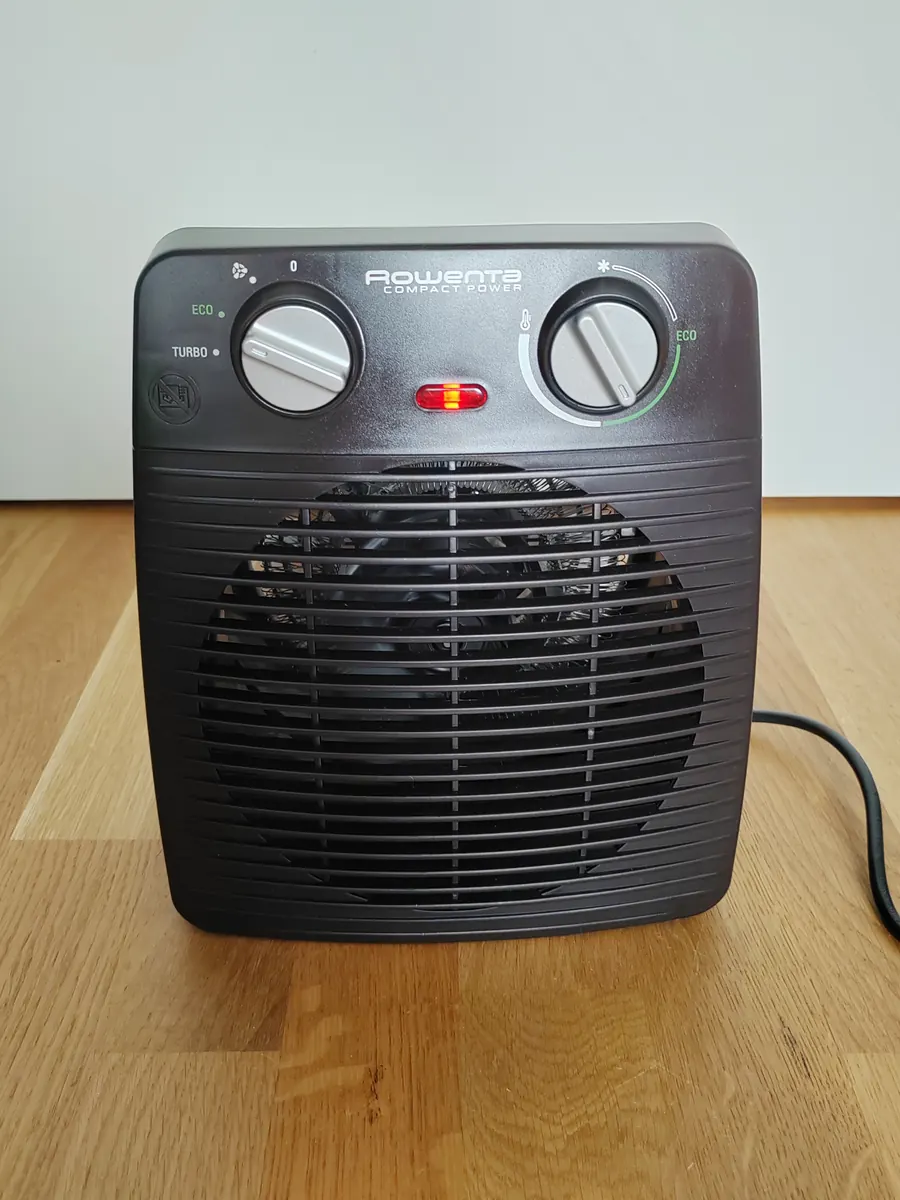
- Rowenta SO2210 Compact PowerAt 60 dB on the highest setting, this box-shaped fan heater was the loudest in my test, and you control it only with two dials, no display. According to Rowenta it has two heat settings up to 2,000 W, a thermostat with frost guard, ECO mode and a cool-air function, but no timer. The stated room size varies between 20 and 40 m² depending on the source. On amazon.co.uk it is only listed as an unavailable import, so the link goes to Amazon Germany (EU plug). (Sources: Rowenta (SO2210), Rowenta (Amazon listing SO2210)) View on Amazon*
This is how I tested
I ordered all eight fan heaters on 29 July 2025 and tried them side by side on 3 August 2025, taking photos as I went. I tested in a living room with a wooden floor and additionally in a tiled room (bathroom/kitchen). It wasn’t a lab: my verdict is based on comparing the heaters directly.
I assessed overall impression, controls, features, build quality, design and noise. I didn’t use a points scale or fixed weighting. For the Test Winner, heat output (by impression), design, noise and features were decisive. I didn’t measure heat output, warm-up or electricity use.
The only thing I measured was noise; I used no other measuring devices. For that I used the smartphone app “Schallpegelmesser” on the highest setting from about 1 m. The app isn’t calibrated, so the values compare the heaters with each other and are not lab values. No value is documented for the Dreo Solaris Slim H3. I mark manufacturer data with H and readings from other publications’ reviews with Q.
I found no current fan heater test by Stiftung Warentest, Germany’s best-known consumer testing organisation; its 2022 article on heating with electricity is a cost comparison behind a paywall (test.de). The German magazine IMTEST, for example, publishes lab results – none of my eight heaters was included.
- Test period: ordered 29 July 2025, tested 3 August 2025
- Rooms: living room with wooden floor, tiled room (bathroom/kitchen)
- Noise: smartphone app “Schallpegelmesser”, not calibrated, highest setting, approx. 1 m
- Not measured: heat output, warm-up time, electricity use
- Features such as timer, remote, oscillation, thermostat and tip-over protection: manufacturer data (H)
About the tester
Maximilian Marx, Bachelor of Engineering (B.Eng.), Munich. For more than 6 years I have been testing and comparing electrical appliances, with a focus on motor technology, acoustics and energy efficiency. I bought every device on this page myself; no manufacturer has any influence on the selection or the result.
Buying advice: what matters
Power and room size
A common rule of thumb, which Rowenta also uses, is about 100 W per m² of floor area. By that rule a 2,000 W heater covers about 20 m² (roughly 215 ft²), and a 1,500 W heater like the Dreo Atom 316 about 15 m². Read bigger manufacturer claims with some scepticism: Rowenta markets the SO2210 for 40 m², which by its own rule of thumb would take 4,000 W. The consumer advice centre of North Rhine-Westphalia in Germany sees fan heaters only for short use in a limited space anyway.
Types and where to use them
A fan heater is essentially a fan plus a heating element: the fan blows air past the element and spreads the warm air around the room. Tower heaters such as the Dreo Solaris Slim H3, PELONIS and Brandson are between 41 and 43.6 cm tall according to the manufacturers and oscillate (Dreo 70°, PELONIS 75°, Brandson switchable). Table-top heaters like the Philips CX3120 (24.9 cm, 1.70 kg) and the Dreo Atom 316 (24.5 cm, 1.38 kg) are more compact. Classic box fan heaters like the Rowenta SO2210 and the Emerio are small boxes with dials; Rowenta itself calls the SO2210 a “Classic Fan Heater”. For an office, noise matters most – up to 50 dB counts as quiet. For a garage, workshop or motorhome, read the manual first: Brandson, for example, only approves its heater for indoor use in well-insulated rooms.
Safety: tip-over protection, plug, distance
Look for tip-over and overheat protection; overheat protection in particular is a must. Plug the heater straight into a wall socket rather than an extension lead – Electrical Safety First warns that leads are easily overloaded. A UK plug carries a fuse of at most 13 A, and most extension leads are rated at 13 A too: at 230 V that is about 2,990 W. A 2,000 W heater draws about 8.7 A; two of them add up to 4,000 W, well over that limit. Keep at least 1 m from walls, furniture, curtains and anything flammable, and never dry clothes on or right next to the heater. A portable heater used in the UK should have a UK 3-pin plug – don’t run an EU-plug heater on a travel adapter.
Noise
Fan heaters up to 50 dB count as quiet, and up to 70 dB is possible, according to the German energy advice service co2online. Of the seven heaters I measured, only the Dreo Atom 316 stayed below 50 dB. The values come from a non-calibrated smartphone app (highest setting, approx. 1 m) and are only good for comparing the heaters with each other:
- Dreo Atom 316: 45 dB
- Philips CX3120/01: 51 dB
- PELONIS ceramic tower heater: 53 dB
- Brandson ceramic tower heater: 54 dB
- Rowenta SO9281 Mini Excel Aqua: 56 dB
- Emerio FH-106737.2: 57 dB
- Rowenta SO2210 Compact Power: 60 dB
- Dreo Solaris Slim H3: n/a (quiet by impression, no value documented)
Thermostat, timer and controls
Three heaters in my test – the Emerio, Rowenta SO2210 and Rowenta SO9281 – only have dials, no display and no thermostat readout. I found that a weakness. Rowenta’s own buying guide says an electronic thermostat regulates more precisely than a mechanical one. According to the manufacturers, five of the eight heaters have a timer: both Dreos, the Philips, the PELONIS and the Brandson. It switches the heater off after the set time, so it can’t keep running if you forget about it.
Ceramic (PTC) fan heater or heating wire
Six of the eight heaters have a ceramic heating element according to the manufacturers; for the Emerio and the Rowenta SO2210 there is no clear statement. A PTC element is usually a ceramic whose resistance rises steeply above a certain temperature, which makes it self-regulating. With a metal heating wire, resistance rises only slightly and evenly. Ceramic smells less because no dust burns on it, and it lasts longer. Trusted Reviews measured a brief start-up peak of 2.4 kW on the Dreo Atom 316.
Running costs: what a fan heater costs per hour
A fan heater turns 1 kWh of electricity into 1 kWh of heat. So the cost is easy to work out: power in kW × hours × price per kWh. I use 26.32p per kWh, the electricity unit rate under the Ofgem price cap from 1 October to 31 December 2026 (average for England, Scotland and Wales, Direct Debit, standard variable tariff; VAT on electricity is suspended until 31 March 2027). Your own rate depends on region, tariff and payment method. The figures apply to continuous running without the thermostat cutting out:
- 2,000 W (full power of most heaters in my test): 2.0 kWh × 26.32p = 52.6p, about 53p per hour
- 1,800 W: 1.8 kWh × 26.32p = 47.4p, about 47p per hour
- 1,500 W (Dreo Atom 316): 1.5 kWh × 26.32p = 39.5p, about 39p per hour
- 1,200 W (middle setting of the Philips CX3120): 1.2 kWh × 26.32p = 31.6p, about 32p per hour
- 1,000 W (low setting of the Brandson and Rowenta SO9281): 1.0 kWh × 26.32p = 26.3p, about 26p per hour
- 900 W (lowest setting of the Philips CX3120): 0.9 kWh × 26.32p = 23.7p, about 24p per hour
If a 2,000 W heater runs 2 h every day, a month (30 days) adds up to 120 kWh – about £31.58. A bathroom example: pre-heating for a quarter of an hour a day at 1,000 W uses 0.25 kWh and costs about 6.6p. Over a heating season from October to April (212 days) that comes to about £13.95 – at today’s cap, which Ofgem resets every quarter.
There is no such thing as an “energy-efficient” fan heater: more watts heat faster and use correspondingly more electricity. You can only save through running time and the thermostat. How much that brings shows a measurement by Trusted Reviews on the Dreo Atom 316: in ECO mode it used 0.51 kWh in one hour instead of 1.5 kWh in continuous mode, so 13.4p instead of 39.5p – about 66 % less. That only applies to that test room (starting at 18.4 °C, target 21 °C).
As main heating, a fan heater is too expensive. Under the same Ofgem cap, gas costs 7.97p per kWh, so a kWh of heat from a fan heater costs more than three times as much (boiler losses not included). The consumer advice centre of North Rhine-Westphalia therefore recommends short, local use, and notes that every degree less room temperature saves about 6 per cent energy. You’ll find more heating topics in my overview Heating.
Fan heaters in the bathroom: UK rules and safety
Bathroom zones under BS 7671
In the UK, Section 701 of BS 7671 (the IET Wiring Regulations) divides rooms with a bath or shower into zones. Zone 0 is the inside of the bath or shower tray, zone 1 is the space above it up to 2.25 m, and zone 2 reaches 0.6 m beyond zone 1. Zone 1 only takes fixed equipment, and equipment in zones 1 and 2 needs at least IPX4. Standard 13 A sockets must be at least 2.5 m horizontally from the edge of zone 1 and protected by a 30 mA RCD; before Amendment 2 (2022) the distance was 3 m.
In practice that rules out a plug-in heater in many small bathrooms: where no spot is 2.5 m away from zone 1, there can’t be a 13 A socket at all, and Electrical Safety First advises against running an extension lead into the bathroom. For lasting warmth, a fixed heater wired in by an electrician and operated by a pull-cord switch is the safer route. Whether a portable heater may be used in your bathroom is best checked with a registered electrician and the manual.
Splash protection
For bathrooms, look for at least IPX4, and never put wet towels on or over the heater. In my test only the Rowenta SO9281 Mini Excel Aqua had splash protection. Rowenta’s safety sheet states IPX1 (vertical drops), MediaMarkt states IP21 – both less than IPX4, so it belongs outside the zones. The Brandson (IP20) and the Emerio (manual: not near a bath or shower) don’t belong in a bathroom at all.
More on bathroom heaters
Which heaters I recommend specifically for bathrooms is on my page best bathroom fan heaters. A fan heater only warms the air; it doesn’t take moisture out of the room. If your bathroom is damp all the time, a dehumidifier will help more, along with regular airing.
Fan heater FAQs
How much electricity does a fan heater use per hour?
As much as its power rating says: a 2,000 W heater uses 2.0 kWh per hour on full power, a 1,500 W model like the Dreo Atom 316 uses 1.5 kWh. With a thermostat, consumption drops once the room is warm: Trusted Reviews measured 0.51 kWh in one hour in ECO mode on the Atom 316. I didn’t measure electricity use myself.
How much does a fan heater cost to run per hour?
At 26.32p per kWh (Ofgem price cap, October to December 2026), an hour at 2,000 W costs about 53p, at 1,500 W about 39p and at 1,000 W about 26p. The formula is power in kW × hours × price per kWh, so just put in your own tariff’s unit rate. If the thermostat cuts out in between, it gets cheaper.
Which is the best fan heater?
In my test, the Dreo Solaris Slim H3: compared directly with seven other heaters, it convinced me most on heat output, design, noise and features. For small rooms the Dreo Atom 316 is the compact alternative with the lowest reading in my test (45 dB). For bathrooms, only the Rowenta SO9281 Mini Excel Aqua with splash protection comes into question from my test.
Which fan heater is the quietest?
Of the seven heaters with a reading in my test, the Dreo Atom 316: 45 dB on the highest setting, recorded with a non-calibrated smartphone app from about 1 m. There is no value for the Dreo Solaris Slim H3. The loudest was the Rowenta SO2210 at 60 dB. Trusted Reviews measured 44 dB from 1 m on the Atom 316. Up to 50 dB counts as quiet.
How many watts does a fan heater need?
A common rule of thumb is about 100 W per m². That means 2,000 W for a 20 m² room and 1,500 W for 15 m². Most heaters in my test deliver up to 2,000 W according to the manufacturers. A fan heater can only heat larger areas at high running costs – it isn’t designed as main heating.
Are there independent lab tests of fan heaters?
For my eight heaters, I only found measured results from Trusted Reviews (Dreo Atom 316 and Solaris Slim H3). Germany’s Stiftung Warentest has no current fan heater test, and the German lab test by IMTEST, won by the Dyson Hot+Cool HF1, included none of my eight. My own test covers noise readings and hands-on impressions, not heat output.
Can I use a fan heater in a UK bathroom?
Only with care. BS 7671 only allows standard 13 A sockets in a bathroom at least 2.5 m horizontally from zone 1, and Electrical Safety First advises against extension leads there. Keep a portable heater outside the zones and away from water, and never put wet towels on it. In my test only the Rowenta SO9281 Mini Excel Aqua had splash protection. For permanent heat, a fixed, hard-wired heater is safer.
Which fan heater is the most energy efficient?
None, really: a fan heater turns 1 kWh of electricity into 1 kWh of heat. You only save by heating for less time, on a lower setting or with a thermostat. Trusted Reviews measured 0.51 kWh instead of 1.5 kWh per hour on the Dreo Atom 316 in ECO mode – at 26.32p per kWh that is 13p instead of 39p. A timer also stops the heater running when nobody needs it.
Conclusion
My Test Winner is the Dreo Solaris Slim H3: in a direct comparison of the eight heaters it convinced me on heat output, design, noise and features. Quietest Tested is the compact Dreo Atom 316 at 45 dB, the lowest reading in my test. Best Tower Alternative is the PELONIS, and my Bathroom Pick is the Rowenta SO9281 Mini Excel Aqua as the only heater with splash protection – in a UK bathroom only outside the zones. I don’t recommend the Emerio, the loud Rowenta SO2210 (60 dB) or the cheap-feeling Brandson.
Sources
- Ofgem: Changes to energy price cap between 1 October and 31 December 2026 (published 26 August 2026)
- SELECT: Electrical installations in locations containing a bath or shower – pocket guide to Section 701 of BS 7671:2018+A2:2022
- IET Wiring Matters: BS 7671:2018 frequently asked questions (September 2019, before Amendment 2)
- Electrical Safety First: Electrical safety advice for the bathroom
- Electrical Safety First: Electrical safety advice for portable heaters
- Verbraucherzentrale NRW (German consumer advice centre): plug-in mini heaters and fan heaters bring no savings
- home&smart (German review site): what an hour of fan heater use really costs (22 October 2026)
- Stiftung Warentest (German consumer testing organisation): heating with electricity instead of gas (2022, paywall)
- co2online (German energy advice service): fan heater guide
- Rowenta Germany: how to choose a fan heater (buying guide)
- IMTEST (German magazine): fan heater test (13 October 2026)
- Wikipedia (German): PTC thermistor – physics basics
- Dreo: Solaris Slim H3 (DR-HSH003), manufacturer/seller data in the Amazon Germany listing
- Dreo USA: Solaris Slim H3 Space Heater (120 V version)
- Dreo support: Solaris Slim H3
- Dreo Germany: Solaris Slim H3S (successor model)
- Dreo Germany: Heater 316
- Dreo USA: Atom 316 Ceramic Space Heater
- Dreo: Heater 316 (DR-HSH006), manufacturer/seller data in the Amazon Germany listing
- amazon.co.uk product listings of the tested heaters (model numbers and titles), retrieved 26 October 2026
- Philips: Compact Ceramic Heater 3000 Series CX3120/01
- PELONIS: ceramic tower heater PHF171BPBHDE, seller data in the Amazon Germany listing
- Brandson: 2000 W fan heater with remote (303124), manufacturer/seller data in the Amazon Germany listing
- testbericht.de: Brandson 303124 ceramic fan heater (data sheet)
- Emerio: instruction manual and ErP information FH-106737.2
- Rowenta Germany: Compact Power SO2210
- Rowenta: SO2210 Compact Power, data in the Amazon Germany listing
- Rowenta Germany: Mini Excel Aqua fan heater SO9281
- Rowenta: instructions for use / FAQ SO9281F0
- MediaMarkt Germany: best fan heaters in tests (buying guide, 6 October 2026)
- Trusted Reviews: Dreo Atom 316 review (16 February 2024)
- Ideal Home: Dreo Atom 316 ceramic fan heater review (27 February 2026)
- Trusted Reviews: Dreo Solaris Slim H3 review (25 January 2023)
- home&smart (German review site): fan heater test 2026
- TopRatgeber24 (German comparison site): PELONIS heater in its 2026 fan heater comparison (algorithm-based, no test)
- My own noise measurements with the smartphone app “Schallpegelmesser” (not calibrated), August 2025
Localised for the UK on 26 October 2026 from the German page (my own hands-on test on 3 August 2025); running costs recalculated at the Ofgem price cap, bathroom section adapted to BS 7671.
